Table of Contents
- Key Takeaways
- How Much Does Solar Panel Installation Cost in 2026?
- Solar Panel Installation Cost by Country
- Solar Panel Cost Per Watt Explained
- What Affects the Cost of Solar Panel Installation?
- Solar Panel Installation Cost by System Size
- Cost Breakdown: Where Your Money Actually Goes
- Solar Battery Storage Cost
- Solar Incentives and Tax Credits in 2026
- Solar Panel Cost vs. Long-Term Savings (ROI)
- Pros and Cons of Going Solar in 2026
- How to Calculate Your Own Solar Installation Cost
- Common Mistakes to Avoid When Budgeting for Solar
- Best Practices Before Signing a Solar Contract
- Expert Insight
- Frequently Asked Questions
- Conclusion
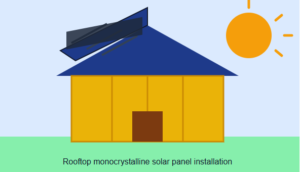 Rooftop monocrystalline solar panel installation
Key Takeaways
- The average solar panel installation cost in the US in 2026 is roughly $2.50–$3.80 per watt, putting a typical 7–8 kW home system at $18,000–$30,000 before incentives.
- Solar panels themselves make up only around 12–15% of total system cost the rest is inverters, mounting, wiring, labor, permits, and overhead.
- The federal residential solar tax credit expired for individual homeowners at the end of 2025; state, utility, and local incentives are now the main lever for lowering US solar costs in 2026.
- UK homeowners pay roughly £1,300–£1,800 per kW installed, with 0% VAT on solar installations in place until March 2027.
- Canadian solar costs run about $2.40–$3.50 CAD per watt, with the 30% federal Clean Technology Investment Tax Credit and province-specific rebates (like Ontario’s HRSP) reducing net costs.
- Australia has some of the cheapest solar in the world at roughly $0.90–$1.30 AUD per watt thanks to the federal STC rebate scheme and a mature, highly competitive installer market.
- Italy and much of Europe pay around €1,300–€2,500 per kW, with tax-deduction schemes like Italy’s Bonus Casa (50% IRPEF deduction) softening the upfront hit.
- Most homeowners recover their solar investment in 4–13 years depending on local electricity prices, sunlight hours, and incentive structure, then enjoy 15+ years of near-free electricity.
How Much Does Solar Panel Installation Cost in 2026?
Across most developed markets, a fully installed residential solar power system costs between $2.50 and $3.80 per watt (or per-watt equivalent) before incentives. For an average home needing a 6–10 kW system, that translates to a gross solar installation cost of roughly $18,000–$35,000 USD, £6,500–£12,000 GBP, $18,000–$30,000 CAD, $5,000–$10,000 AUD, or €7,000–€13,000 EUR. After applicable tax credits, rebates, and VAT reductions, most households pay 20–50% less than the sticker price.
These figures cover a “turnkey” installation: solar panels, inverter(s), racking and mounting hardware, DC/AC wiring, permitting, interconnection paperwork, and professional labor. Battery storage, roof repairs, electrical panel upgrades, and premium equipment brands are typically priced separately and can add anywhere from a few thousand to well over $20,000 to your total solar panel installation cost.
Solar Panel Installation Cost by Country (2026)
United States: Solar Panel Installation Cost
In 2026, the average cost of solar panels in the US sits between $2.50 and $3.80 per watt installed, according to industry marketplace and consumer research data. A common 7–8 kW residential system costs roughly $20,000 to $30,000 before incentives, while smaller 4–6 kW systems run closer to $12,000–$21,000. Larger 10 kW+ systems with battery backup can exceed $40,000. Pricing varies significantly by state due to differing labor costs, permitting requirements, and local solar incentive programs Arizona and other sunbelt states tend to have the lowest cost per watt, while states like Nebraska and South Dakota trend higher.
An important 2026 update: the 30% federal residential solar tax credit that homeowners could claim directly expired at the end of 2025. A related federal credit still exists for business-claimed solar arrangements (such as leases and power purchase agreements), meaning homeowners can still access indirect federal savings through third-party-owned systems, but a straight cash or loan purchase in 2026 no longer qualifies for that direct 30% deduction. State and utility-level incentives remain the primary way to lower your out-of-pocket solar installation cost in the US this year.
United Kingdom: Solar Panel Installation Cost
UK solar pricing is usually quoted as a total installed price rather than per-watt. A standard 4 kW system for a 3-bedroom home costs roughly £6,500–£8,500 fully installed in 2026, with the MCS-registered national average landing around £7,800–£8,700. Add a 4–5 kWh battery and the total climbs to roughly £10,000–£14,000. On a per-kW basis, expect to pay about £1,300–£1,800 per kW.
The UK’s biggest financial lever right now is VAT: solar panel and battery installations remain zero-rated for VAT until 31 March 2027 (rising to 5% after that date), which alone saves homeowners £1,000–£3,000 compared with a standard 20% VAT rate. Regional pricing varies too the South East of England tends to be the most expensive region, while the North East is typically the cheapest.
Canada: Solar Panel Installation Cost
Canadian homeowners pay roughly $2.40–$3.50 CAD per watt installed in 2026, putting a typical 7.5–10 kW grid-tied system at $18,000–$35,000 CAD before incentives. Ontario is among the most competitively priced provinces at $2.42–$3.50/W thanks to a dense installer network, while Alberta and British Columbia sit in a similar $2.60–$3.27/W range. The federal Canada Greener Homes Grant and Loan programs both closed to new applicants in 2025, so provincial programs like Ontario’s Home Renovation Savings Program, which offers up to $5,000 for solar plus $5,000 for battery storage now do the heavy lifting on incentive savings.
Australia: Solar Panel Installation Cost
Australia consistently has some of the lowest solar panel installation costs in the world, averaging around $0.90–$1.30 AUD per watt after the federal Small-scale Technology Certificate (STC) rebate is applied at point of sale. A 6.6 kW system the most popular residential size typically costs $4,000–$8,500 AUD, while a larger 10 kW system runs about $8,000–$12,000 AUD. A simple rule of thumb used across the industry: budget roughly $1,000 AUD per kW installed for a good-quality system.
Italy & Europe: Solar Panel Installation Cost
In Italy, a residential photovoltaic (“fotovoltaico”) system costs roughly €1,300–€2,500 per kW installed. A common 3 kW system for a small household starts around €4,000–€6,000, while the most popular 6 kW size for a single-family home runs €7,000–€13,000, or up to €13,500–€21,000 with a battery storage system included. Italy’s main incentive in 2026 is the Bonus Casa scheme, which lets homeowners recover 50% of eligible solar costs as an IRPEF tax deduction spread over 10 years — though the rate is scheduled to revert to the ordinary 36% from 2027 onward. Broader European averages track closely with Italy, generally landing between €1,200 and €2,800 per kW depending on national VAT rates, labor costs, and local subsidy schemes.
Global Solar Panel Installation Cost Comparison Table
| Country | Typical Cost Per Watt/kW | Common System Size | Typical Total Cost (Before Incentives) | Key 2026 Incentive |
|---|---|---|---|---|
| United States | $2.50–$3.80/W | 7–8 kW | $20,000–$30,000 | State & utility rebates (federal credit for homeowners expired end of 2025) |
| United Kingdom | £1,300–£1,800/kW | 4 kW | £6,500–£8,500 | 0% VAT until March 2027 |
| Canada | $2.40–$3.50 CAD/W | 7.5–10 kW | $18,000–$35,000 CAD | 30% Clean Technology ITC + provincial rebates |
| Australia | $0.90–$1.30 AUD/W | 6.6 kW | $4,000–$8,500 AUD | Federal STC rebate |
| Italy / Europe | €1,300–€2,500/kW | 6 kW | €7,000–€13,000 | Bonus Casa 50% IRPEF deduction (Italy) |
Figures are national averages compiled from 2026 industry and consumer-research sources; actual solar quotes vary by installer, roof type, and region.
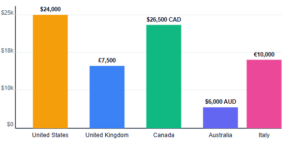
Typical Mid-Range Solar Installation Cost by Country (2026)
Solar Panel Cost Per Watt Explained
“Cost per watt” ($/W) is the standard unit the solar industry uses to compare quotes of different sizes fairly similar to how “price per square foot” works for real estate. You calculate it by dividing the total installed price by the system’s wattage. A $24,000 quote for an 8,000-watt (8 kW) system, for example, works out to $3.00 per watt.
As a general guideline for 2026: if your quoted cost per watt is close to $2.00–$2.50, you’re getting a strong deal; $2.50–$3.50 is a normal, fair market range; and anything consistently above $4.00 per watt (outside of complex roofs or premium-tier equipment) is worth negotiating or comparing against additional quotes.
What Affects the Cost of Solar Panel Installation?
System Size (kW)
Larger systems cost more in total but usually less per watt, because fixed costs like permitting, design, and customer acquisition are spread across more panels. Your ideal system size depends on your annual electricity usage as a rule of thumb, US homes need roughly 1 kW of solar for every 1,200–1,600 kWh of yearly electricity consumption.
Panel Type: Monocrystalline vs. Polycrystalline
Monocrystalline panels are the 2026 industry default for residential installs. They’re more efficient and take up less roof space, but cost more typically $0.90–$1.10 per watt for the panel alone. Polycrystalline panels are cheaper ($0.70–$0.90/W) but slightly less efficient, making them a reasonable option only if you have generous roof space.
Roof Complexity and Access
Steep pitches, multiple roof faces, unusual shapes, fragile or slate roofing, and difficult access can all add scaffolding, specialized mounting hardware, and extra labor hours sometimes adding thousands to your final solar panel installation cost.
Labor Rates and Location
Installation labor costs vary widely by region due to differences in wages, licensing requirements, and the density of local installers. Urban markets with high demand and limited installer availability often quote more than competitive suburban or regional markets.
Battery Storage
Adding home battery storage is the fastest-growing add-on in 2026 and can add anywhere from $7,000–$18,000 in the US, £3,000–£5,000+ in the UK, or several thousand in local currency elsewhere, depending on capacity.
Inverter Type
String inverters are the most affordable option; microinverters and power optimizers cost more (often 15–20% extra) but perform noticeably better on roofs with partial shading or multiple orientations.
Permits, Interconnection, and Paperwork
Local permitting fees, utility interconnection applications, and certification paperwork (like the UK’s MCS documentation or Canada’s ESA inspection) are usually bundled into “turnkey” quotes but can be itemized separately by some installers always check.
Solar Panel Installation Cost by System Size (US Example)
| System Size | Typical Household Fit | Estimated Cost (Before Incentives) |
|---|---|---|
| 4–6 kW | Small home / partial bill offset | $12,000–$21,000 |
| 7–10 kW | Average family home (most common) | $18,000–$35,000 |
| 10–12 kW | Larger home, EV charging, heat pump | $28,000–$45,000 |
| 12 kW+ | High energy use / whole-home battery backup | $40,000+ |
Cost Breakdown: Where Your Money Actually Goes
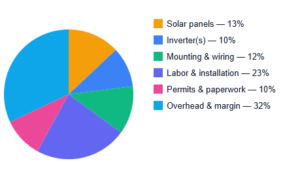
A common misconception is that the panels themselves make up most of the solar installation cost. In reality, solar panels typically account for only around 12–15% of total system price. The rest breaks down roughly like this:
- Solar panels: ~12–15%
- Inverter(s): ~10%
- Racking, mounting hardware, and wiring: ~10–15%
- Labor and installation: ~20–25%
- Permits, inspections, and interconnection paperwork: ~10%
- Sales, design, overhead, and installer margin: remainder
This is why comparing quotes purely on panel brand can be misleading the equipment is a smaller lever on total cost than most homeowners assume.
Solar Battery Storage Cost
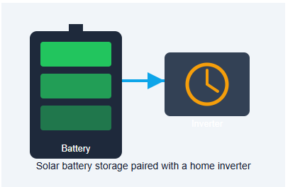
Battery storage has become one of the biggest cost decisions in 2026 solar quotes. In the US, a home battery adds roughly $7,000–$18,000 depending on capacity and brand. In the UK, a 4–5 kWh battery typically adds £3,000–£5,000. In Australia, batteries have their own growing rebate schemes that are increasingly more generous than the panel-only STC rebate. Batteries increase self-consumption of your own solar power (useful where export/feed-in rates are low) and provide backup power during outages, but they also extend your payback period, so they’re worth modeling separately from your core solar panel installation cost.
Solar Incentives and Tax Credits in 2026
United States
The direct 30% federal residential solar tax credit ended for individual homeowner purchases after December 31, 2025. A federal credit remains available through business-claimed, third-party-owned solar structures (leases, PPAs, and similar prepaid arrangements). State-level incentives property tax exemptions, sales tax exemptions, and utility rebates are now the primary savings mechanism; states like New York, Massachusetts, and New Jersey remain particularly generous.
United Kingdom
0% VAT on residential solar panel and battery installations remains in effect until 31 March 2027 (rising to 5% afterward). The Smart Export Guarantee (SEG) lets homeowners earn money for excess electricity exported to the grid, and targeted schemes like ECO4 and the Warm Homes Local Grant can help lower-income households further.
Canada
The 30% federal Clean Technology Investment Tax Credit applies to eligible solar and battery installations. Provincial programs vary Ontario’s Home Renovation Savings Program offers up to $10,000 combined for solar and battery, while most provinces offer net metering that credits exported solar power at or near the retail electricity rate.
Australia
The federal Small-scale Technology Certificate (STC) scheme is applied automatically at point of sale by installers, discounting the upfront price of the system. STC values step down annually, so earlier installation generally means a larger discount. Several states also run separate, increasingly generous battery-specific rebates.
Italy
Italy’s Bonus Casa scheme allows homeowners to deduct 50% of eligible solar and battery costs from IRPEF income tax, spread over 10 years, through 31 December 2026 (reverting to the ordinary 36% rate from 2027). Some regions, including Puglia and Sardinia, also offer the “Reddito Energetico” grant of up to €8,500 for qualifying lower-income households.
Solar Panel Cost vs. Long-Term Savings (ROI)
Solar is ultimately judged on payback period how long it takes for electricity bill savings and incentives to cover your solar panel installation cost.
| Country | Typical Payback Period | Typical 25-Year Savings |
|---|---|---|
| United States | 6–13 years | $41,000–$155,000 |
| United Kingdom | 6–12 years | £10,000+ profit after payback |
| Canada | 7–12 years | Thousands per year post-payback |
| Australia | 3–8 years | $1,200–$2,500/year post-payback |
| Italy | 5–8 years | €700–€2,000/year post-payback |
Faster-rising electricity prices shorten your payback period, while cheaper solar installation costs and strong net-metering or export-payment schemes both improve your long-term return. Research from national renewable energy agencies also links solar installations to a measurable bump in home resale value often cited at roughly $4 of added value for every $1 of annual electricity savings.

Pros and Cons of Going Solar in 2026
| Pros | Cons |
|---|---|
| Reduces or eliminates monthly electricity bills | High upfront solar panel installation cost |
| 25+ year equipment lifespan and strong warranties | Payback period of several years before net savings begin |
| Protects against rising utility electricity rates | Roof condition, shading, or orientation may limit output |
| Increases home resale value in most markets | Financing (loans/leases) can raise total lifetime cost |
| Reduces household carbon footprint | Incentive landscape changes yearly and varies by region |
How to Calculate Your Own Solar Installation Cost
- Pull your annual electricity usage from your last 12 months of utility bills (in kWh).
- Estimate system size: divide annual kWh usage by roughly 1,200–1,600 (US) or your local equivalent based on regional sunlight hours.
- Apply a realistic installed cost per watt for your country using the ranges above.
- Subtract eligible incentives: confirm current federal, state/provincial, and utility programs before assuming any specific rebate applies.
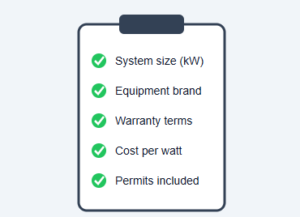
- Get at least three installer quotes and compare system size, panel and inverter brand, expected annual production, warranty terms, and total installed price not just the headline number.
Common Mistakes to Avoid When Budgeting for Solar
- Comparing quotes on price alone without checking system size, equipment tier, and warranty coverage.
- Assuming outdated incentive rules still apply especially the expired US federal homeowner tax credit.
- Undersizing the system to save money upfront, which limits long-term bill savings.
- Ignoring roof condition installing solar on a roof that needs replacement within 5–10 years adds costly rework later.
- Overlooking financing costs solar loans can add 20–43% to total lifetime cost compared with a cash purchase.
- Skipping multiple quotes pricing for the same system size can vary by thousands between installers.
Best Practices Before Signing a Solar Contract
- Request an itemized quote showing panels, inverter, mounting, labor, permits, and any battery costs separately.
- Confirm the installer’s certification (e.g., NABCEP in the US, MCS in the UK, CEC in Australia, ESA-licensed crews in Canada).
- Ask for a production guarantee and clarify whether warranties cover equipment, workmanship, or both.
- Verify net metering, export tariff, or feed-in arrangements with your local utility before finalizing system size.
- Get everything pricing, timeline, and warranty terms in writing before paying a deposit.
Expert Insight
Industry analysts consistently point to one rule that cuts through most of the confusion around solar panel installation cost: focus on the total installed price per watt, not the price of the panels alone. Two quotes for the “same” 8 kW system can differ by thousands of dollars once you account for inverter quality, roof complexity, permitting fees, and installer overhead which is exactly why comparing at least three like-for-like quotes, with matching system size and production estimates, remains the single most effective way to avoid overpaying in 2026’s solar market.
Frequently Asked Questions
How much does it cost to install solar panels on an average house?
In 2026, most homeowners pay between $18,000 and $30,000 in the US, £6,500–£8,500 in the UK, $18,000–$30,000 CAD in Canada, $4,000–$8,500 AUD in Australia, or €7,000–€13,000 in Italy, before incentives, for a standard residential system.
What is the average cost per watt for solar panels in 2026?
The global average installed cost typically falls between $2.00 and $3.80 per watt (or local currency equivalent), depending on country, system size, and equipment tier.
Do solar panels still qualify for a federal tax credit in the US?
The direct 30% federal tax credit for homeowner-purchased residential solar expired after December 31, 2025. A federal credit remains available only through business-claimed, third-party-owned solar arrangements such as leases and PPAs in 2026.
Is solar panel installation cheaper in Australia than the US?
Yes. On a per-watt basis, Australia is one of the cheapest solar markets in the world, largely due to the federal STC rebate and a highly competitive installer market, with costs around $0.90–$1.30 AUD per watt versus $2.50–$3.80 per watt in the US.
How long does it take for solar panels to pay for themselves?
Most homeowners reach payback within 4–13 years depending on local electricity prices, sunlight hours, system size, and available incentives, followed by 15+ years of largely free electricity.
Does adding a battery increase solar panel installation cost significantly?
Yes battery storage is one of the largest optional add-ons, typically adding $7,000–$18,000 in the US or several thousand pounds/euros/dollars elsewhere, depending on capacity and brand.
What size solar system does an average home need?
Most homes need a system between 6 kW and 10 kW to offset the majority of their annual electricity usage, though the right size depends on your specific consumption, roof space, and local sunlight hours.
Are monocrystalline panels worth the extra cost?
For most homeowners with limited roof space, yes monocrystalline panels are more efficient and perform better in low light, which can offset their higher per-watt price by requiring fewer panels for the same output.
How many quotes should I get before installing solar panels?
Industry experts recommend at least three quotes from different installers so you can compare system size, equipment brand, warranty terms, and total installed cost per watt on a like-for-like basis.
Does solar panel installation increase home value?
Research from renewable energy agencies links solar installations to increased resale value, with some studies estimating roughly $4 of added home value for every $1 reduction in annual electricity costs.
Is it cheaper to finance solar panels with a loan or pay cash?
Cash purchases typically offer the best long-term return, since solar loans can add 20–43% to total lifetime cost through interest and dealer fees, even though they lower the upfront barrier to going solar.
Conclusion
Solar panel installation cost in 2026 varies widely by country, system size, and equipment choice, but the fundamentals are consistent everywhere: get your system sized to your actual electricity usage, understand what’s included in your quote beyond just the panels, confirm which incentives genuinely still apply in your region this year, and always compare at least three like-for-like installer quotes before signing. Do that, and solar remains one of the most reliable, long-term investments a homeowner can make regardless of whether you’re budgeting in dollars, pounds, or euros.
1 thought on “Solar Panel Installation Cost in 2026: The Complete Global Pricing Guide (US, UK, Canada, Australia & Europe)”