A guest room and a TV room ask for two very different things from a home: one needs to feel like a warm, welcoming hotel suite for people who don’t live there full-time, and the other needs to be the most comfortable, functional spot in the house for everyday relaxing, movie nights, and game days. Get both right, and your home instantly feels more finished, more livable, and more “you.”
A beautiful, functional guest bedroom and TV/media room from layout and color palettes to lighting, furniture, budget breakdowns, small-space solutions, and the mistakes that quietly make both rooms feel unfinished. Whether you’re working with a spare bedroom, a converted den, or a dedicated media room, you’ll find practical, design-backed guest room and TV room decoration ideas you can actually use.
Table of Contents
- 1. Why Guest Rooms and TV Rooms Deserve Real Design Attention
- 2. Guest Room Decoration: The Essentials Checklist
- 3. Guest Room Decoration Ideas by Style
- 4. Small Guest Room and Multi-Purpose Room Ideas
- 5. TV Room Layout and Planning Fundamentals
- 6. TV Room Decoration Ideas by Style
- 7. TV Wall Design Ideas
- 8. Lighting Ideas for Guest Rooms and TV Rooms
- 9. Common Decorating Mistakes to Avoid
- 10. Budget Breakdown: What It Costs to Decorate Both Rooms
- 11. Pros and Cons of a Dedicated Guest Room vs. Multi-Purpose Room
- 12. Best Practices for Long-Term Style and Function
- 13. Expert Insights and Data-Backed Trends
- 14. Key Takeaways
- 15. Frequently Asked Questions
- 16. Conclusion
1. Why Guest Rooms and TV Rooms Deserve Real Design Attention
It’s easy to treat the guest room as a storage overflow zone and the TV room as “just the room with the couch.” But these two spaces get more emotional attention from visitors and family than almost any other room in the house. A guest room tells visitors how much thought you put into their comfort. A TV room, meanwhile, is often where a household spends the most collective hours together outside the kitchen which makes its layout, lighting, and furniture choices directly tied to daily comfort and family time.
Designers increasingly treat both rooms as flexible, multi-functional spaces rather than single-purpose rooms, which is why this guide covers both classic, dedicated-room decorating and smart multi-purpose layouts for smaller homes.
2. Guest Room Decoration: The Essentials Checklist
The Non-Negotiables Every Guest Room Needs
- A comfortable, properly sized bed: A queen bed is the sweet spot for most guest rooms; a full or even a well-dressed daybed works for smaller spaces.
- Quality bedding: Hotel-style layered bedding a fitted sheet, flat sheet, duvet or comforter, and 2–4 pillows in mixed firmness instantly upgrades the guest experience.
- A nightstand with a lamp on each side of the bed (or at minimum one), so guests aren’t fumbling for an overhead switch.
- Accessible storage: An empty drawer or two and a few free hangers in the closet tells guests they’re welcome to unpack, not just “stay over.”
- Blackout or room-darkening window treatments so guests can sleep past sunrise.
- A full-length or vanity mirror.
- A luggage rack or bench so suitcases aren’t left on the floor.
- Fresh towels, an extra blanket, and simple welcome touches like water, local snacks, or a phone charger.
Color Palettes That Work in Almost Any Guest Room
Neutral, calming palettes tend to perform best in guest rooms because they’re inoffensive to a wide range of tastes and photograph beautifully for listings or rentals. Popular 2026 palettes include warm greige and taupe, soft sage green with cream, muted terracotta with white, and classic navy-and-white for a crisp, hotel-inspired look. Add personality through textiles a patterned throw pillow, a woven wall hanging, or a piece of local art rather than bold wall paint that may not suit every guest.
3. Guest Room Decoration Ideas by Style
Hotel-Inspired Guest Room
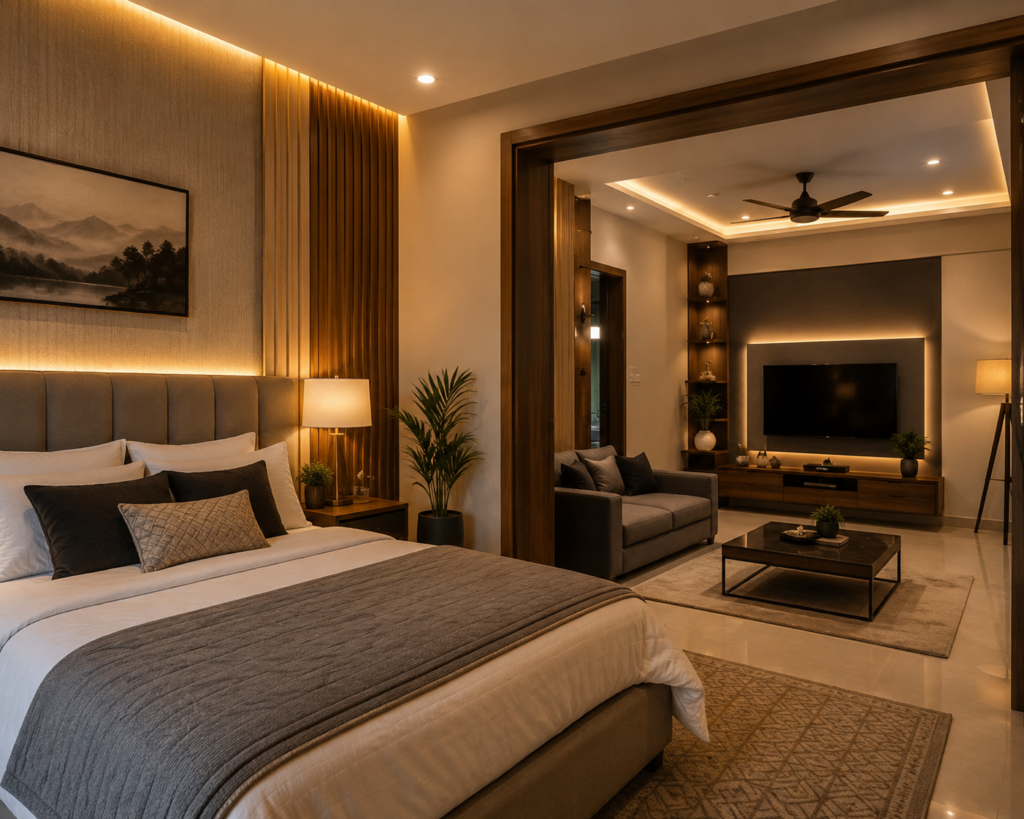
Layered white or neutral bedding, a luggage rack, a small tray with water glasses, and matching bedside lamps recreate a boutique-hotel feel. Keep surfaces clutter-free and add one statement piece an oversized headboard or a framed art print as the visual anchor.
Cozy Farmhouse Guest Room
Warm wood tones, a woven throw at the foot of the bed, linen curtains, and a vintage-style mirror create an inviting, lived-in feel. Shiplap or wood-panel accent walls pair especially well with this style.
Modern Minimalist Guest Room
A platform bed, monochrome bedding, hidden storage, and a single sculptural light fixture keep the room visually calm ideal for smaller rooms where clutter reads as chaos rather than charm.
Boho Guest Room
Layered textures a jute rug, macramé wall hanging, rattan headboard, and mixed-pattern pillows create a relaxed, personality-filled space that photographs well and feels distinctly non-corporate.
Coastal / Airy Guest Room
Soft blues and whites, linen or cotton bedding, natural fiber rugs, and light wood furniture create a bright, breezy guest room that works particularly well in rooms with good natural light.
4. Small Guest Room and Multi-Purpose Room Ideas
Most homes don’t have a dedicated guest room sitting empty year-round and design experts agree that’s fine. A well-designed multi-purpose room can serve guests just as well as a single-use bedroom.
Home Office + Guest Room
A quality pull-out sofa bed or a Murphy bed with a built-in desk lets the room function as a productive office by day and a comfortable guest suite by night. Choose a sofa bed with a real mattress (not a thin fold-out pad) for genuine comfort.
Playroom + Guest Room
A daybed with a trundle serves double duty as reading-nook seating for kids and an extra bed for overnight guests, while toy storage is concealed in matching baskets or bench seating.
Craft/Hobby Room + Guest Room
Closed cabinet storage keeps hobby supplies out of sight, while a fold-down table clears floor space instantly when the room needs to become a bedroom.
Small Guest Room Layout Tips
- Use a daybed against the wall instead of a centered bed frame to free up floor space.
- Choose furniture with exposed legs it visually opens up a small room compared to boxy, floor-hugging pieces.
- Mount a mirror opposite the window to bounce natural light around the room.
- Use wall-mounted sconces instead of table lamps to free up nightstand space.
5. TV Room Layout and Planning Fundamentals
Ideal TV Viewing Distance
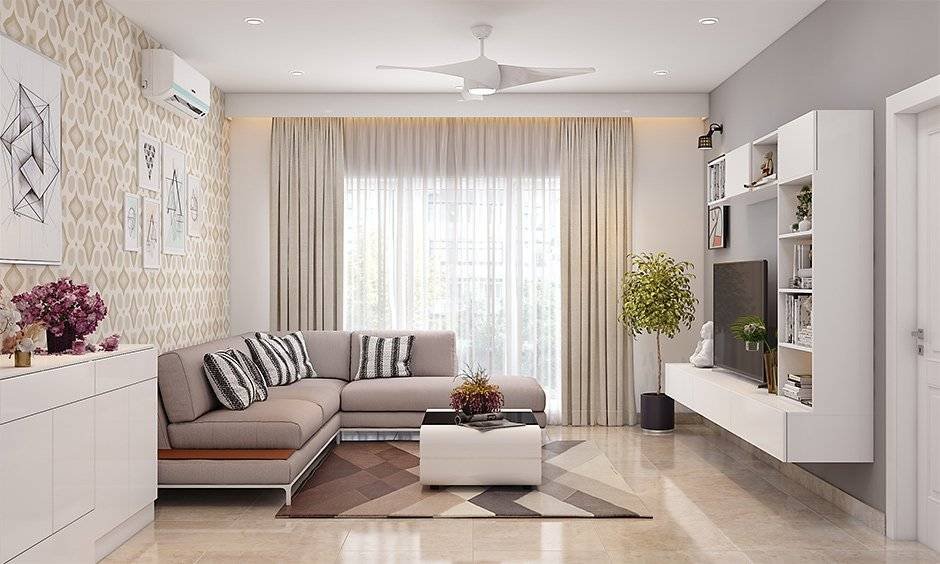
As a general rule of thumb used by home theater designers, seating distance should be roughly 1.5 to 2.5 times the TV’s diagonal screen size. For a 65-inch TV, that translates to seating positioned approximately 8 to 13 feet away for comfortable viewing without eye strain.
Furniture Arrangement Principles
- Anchor the seating around the TV wall, not a window, to avoid glare during daytime viewing.
- Leave 30–36 inches of walking clearance between the coffee table and seating for comfortable movement.
- Use a rug that extends at least a few inches beyond the front legs of your sofa to visually anchor the seating area rather than making furniture look like it’s floating.
- Angle seating slightly if the room is wide, rather than lining everything up in a single straight row facing the screen.
Acoustic and Comfort Considerations
Hard floors, bare windows, and high ceilings all bounce sound and can make dialogue harder to hear. A large area rug, upholstered furniture, and layered curtains all help absorb sound naturally, improving audio clarity without needing dedicated acoustic panels in most standard living rooms.
6. TV Room Decoration Ideas by Style
Modern Media Room
A low-profile media console, sectional sofa, dimmable recessed lighting, and a neutral palette with one bold accent wall create a sleek, contemporary feel ideal for movie nights.
Classic Family TV Room
Durable, stain-resistant upholstery, a large ottoman that doubles as a coffee table and extra seating, closed-storage media consoles to hide remotes and cables, and warm lighting layers make this the most practical option for households with kids or pets.
Cozy Cinema-Style TV Room
Blackout curtains, a large sectional or reclining seats, ambient LED strip lighting behind the TV, and a dedicated snack/beverage station recreate a home-theater feel without a full theater room renovation.
Scandinavian TV Room
Light wood tones, a neutral palette, a wall-mounted TV to keep the floor visually open, and simple, functional furniture keep the room feeling airy and uncluttered.
Industrial TV Room
Exposed brick or a brick-look accent wall, black metal shelving, leather seating, and Edison-bulb fixtures create a moodier, textural media space.
7. TV Wall Design Ideas
- Accent wall behind the TV: A bold paint color, wood slat panels, or textured wallpaper draws the eye and makes the TV feel intentional rather than an afterthought.
- Floating media console: A wall-mounted console beneath the TV creates a clean, modern look and makes floor cleaning easier.
- Gallery wall around (not behind) the TV: Frames arranged around the television rather than directly behind it help the screen blend into the overall wall composition when it’s off.
- Built-in shelving flanking the TV: Symmetrical shelving on either side of a wall-mounted TV adds storage and display space while framing the screen nicely.
- Cable management: In-wall cable channels or a cord cover kit keep the wall looking clean this is one of the single biggest factors in whether a TV wall looks “designed” versus “thrown together.”
8. Lighting Ideas for Guest Rooms and TV Rooms
Guest Room Lighting
Layer at least three light sources: an overhead fixture for general light, bedside lamps for reading, and a soft accent light (like a plug-in nightlight) for guests unfamiliar with the room at night. Warm white bulbs (2700K–3000K) feel more relaxing than cool white in a bedroom setting.
TV Room Lighting
Bias lighting a soft LED strip placed behind the TV reduces eye strain by softening the contrast between a bright screen and a dark wall. Dimmable overhead and lamp lighting lets you shift the room from bright family game night to dim movie-night ambiance without needing to change fixtures.
9. Common Decorating Mistakes to Avoid
- Skipping blackout curtains in the guest room, leaving visitors waking up at sunrise.
- Using the guest room purely as storage overflow with no clear floor space or accessible closet room.
- Mounting the TV too high the center of the screen should sit roughly at eye level when seated, not above a fireplace where necks crane upward.
- Ignoring cable management, leaving a tangle of visible cords beneath a wall-mounted TV.
- Choosing seating that’s too far or too close for the TV’s actual screen size.
- Overcrowding the TV room with too much furniture, blocking natural walking paths.
- Forgetting a mirror or luggage space in the guest room, small details guests notice immediately.
- Choosing all-hard surfaces in a TV room, resulting in poor acoustics and echo.
10. Budget Breakdown: What It Costs to Decorate Both Rooms
| Region | Guest Room Refresh (Budget–Mid Range) | TV Room Refresh (Budget–Mid Range) |
|---|---|---|
| United States | $800 – $3,500 | $1,500 – $6,000+ |
| United Kingdom | £600 – £2,800 | £1,200 – £4,800 |
| Canada | CAD $1,000 – $4,200 | CAD $1,800 – $7,000 |
| Australia | AUD $1,000 – $4,500 | AUD $2,000 – $7,500 |
| Italy / EU average | €700 – €3,000 | €1,300 – €5,200 |
Estimates cover furniture, bedding/textiles, lighting, and basic decor accessories for a standard-sized room, and assume the bed frame, sofa, or TV mount are the largest line items. Costs rise significantly with custom furniture, full renovations, or high-end electronics.
11. Pros and Cons of a Dedicated Guest Room vs. Multi-Purpose Room
| Dedicated Guest Room | Multi-Purpose Guest Room |
|---|---|
| Always ready for guests, no setup required | Room sits unused most of the year without dual purpose |
| Requires giving up a full room year-round | Maximizes square footage in smaller homes |
| Easier to create a cohesive, hotel-like design | Requires furniture that transitions well (sofa beds, Murphy beds) |
| Higher furniture cost (dedicated bed frame + mattress) | Often more budget-friendly overall |
| Best for frequent hosts or homes with extra space | Best for smaller homes or occasional guests |
12. Best Practices for Long-Term Style and Function
- Choose a neutral base palette for large furniture pieces (sofa, bed frame, rug) and update color trends through smaller, cheaper accessories like pillows and throws.
- Measure your room and furniture before buying a sofa or bed that’s even a few inches too large can throw off the entire layout.
- Prioritize comfort testing (sitting on the sofa, lying on the mattress in-store) over photos alone.
- In the TV room, plan cable routing before mounting the TV or arranging furniture, not after.
- Keep a simple “welcome basket” ready to go for the guest room so hosting never feels last-minute.
- Reassess furniture layout any time you rearrange more than one major piece small shifts affect the whole room’s flow.
Expert Insights and Data-Backed Trends
Interior designers consistently point to a few patterns that separate a guest room or TV room that feels professionally styled from one that feels accidental. First, lighting layering matters more than most homeowners expect a room with only a single overhead fixture almost always reads as flat and unfinished on camera and in person, regardless of how nice the furniture is. Second, scale is one of the most common DIY mistakes: an area rug that’s too small, a sofa that overwhelms a narrow room, or a headboard sized for a larger bed frame all throw off the proportions of a space even when every individual item is beautiful on its own.
On the guest room side, hospitality research consistently shows that comfort details a genuinely good mattress, blackout window coverings, and accessible storage influence a guest’s perception of “how welcome I felt” far more than decorative accessories do. For TV rooms, home theater professionals note that screen size and seating distance mismatches are the single most common complaint in living room setups, more so than resolution or sound system quality, which reinforces why layout planning should come before any big-ticket electronics purchase.
A useful rule many professional stagers follow: spend roughly 60% of a room’s decorating budget on the two or three largest pieces (bed frame and mattress, or sofa and TV console) and the remaining 40% on lighting, textiles, and accessories this keeps both function and style in balance rather than overspending on decor while skimping on comfort.
Key Takeaways
- A guest room needs comfort essentials quality bedding, accessible storage, blackout curtains, and good lighting more than expensive decor.
- Multi-purpose guest rooms (office, playroom, or craft room combos) are a smart, space-saving option for smaller homes.
- TV room layout should be built around ideal viewing distance (roughly 1.5–2.5x the screen’s diagonal size) and comfortable furniture spacing.
- Cable management and TV wall design are two of the biggest factors separating a “designed” media room from a cluttered one.
- Neutral, flexible base palettes let both rooms evolve with trends without a full redecorate every few years.
Frequently Asked Questions
1. What size bed is best for a guest room?
A queen bed is the most versatile choice for most guest rooms, comfortably fitting couples and single guests alike. For smaller rooms, a full-size bed or a quality daybed with a trundle works well.
2. How do I make a small guest room feel bigger?
Use a daybed against the wall instead of a centered bed frame, choose furniture with visible legs, hang a mirror opposite the window, and stick to a light, neutral color palette to maximize the sense of space.
3. How far should I sit from my TV?
As a general guideline, seating distance should be about 1.5 to 2.5 times the TV’s diagonal screen size roughly 8 to 13 feet for a 65-inch TV.
4. What height should a TV be mounted?
The center of the screen should sit roughly at eye level when seated, which for most rooms is about 42–48 inches from the floor, depending on seat height.
5. What can double as a guest room besides a spare bedroom?
A home office with a quality pull-out sofa bed or Murphy bed, a playroom with a daybed and trundle, or a den with a comfortable sofa bed can all function as guest spaces without a fully dedicated room.
6. How do I hide TV cables for a clean wall look?
Use an in-wall cable management kit routed behind the drywall, or a surface-mounted cord cover painted to match the wall, to hide cables running from a wall-mounted TV to the media console below.
7. What colors work best for a guest bedroom?
Neutral, calming tones such as soft greige, sage green, warm white, or muted blue tend to suit the widest range of guest preferences and pair easily with any bedding or decor style.
8. How can I improve the sound quality in my TV room?
Add soft furnishings like a large area rug, upholstered seating, and layered curtains to absorb sound and reduce echo, especially in rooms with hard flooring and high ceilings.
9. What lighting is best for a TV room?
Dimmable lighting paired with bias lighting (a soft LED strip behind the TV) reduces eye strain and lets the room shift easily between bright, functional light and relaxed movie-night ambiance.
10. What are guest room essentials I often forget?
A luggage rack or bench, an extra blanket, empty drawer or closet space, a full-length mirror, and a bedside charging option are small details that make a noticeable difference to guests.
11. Should the TV room and living room be the same space?
It depends on your home’s layout and lifestyle combined living/TV rooms work well for smaller homes and social households, while a separate TV or media room suits homes with more square footage or a preference for a quieter, screen-free living room.
Conclusion
A great guest room and a great TV room don’t require a full renovation budget they require the right priorities. For the guest room, that means comfort essentials: a good mattress, layered bedding, real storage space, and thoughtful lighting. For the TV room, it means smart layout planning: the right seating distance, comfortable furniture spacing, clean cable management, and lighting that adapts from bright to cozy. Get those fundamentals right first, then layer in the style hotel-inspired, farmhouse, Scandinavian, or industrial and both rooms will feel finished, functional, and genuinely enjoyable to spend time in.
Looking for more inspiration? Browse our full room decoration ideas hub, check out our 75 living room decoration ideas for more TV-area inspiration, or explore home accessories for the finishing touches in both rooms.
Written & reviewed by the EzHomeAura Home
You can read our more articles click here